Why PRISM
Why Prism
Sub-100 nm nano pigment dispersion and long experience with dye and pigment inks
Why PRISM
Why choose Prism Technology?
World-class sub-100 nm pigment dispersion technology and long experience commercializing dye and pigment inkjet inks.
-
Why nano dispersion?
Particle stability and color gamut
A stable nano-size dispersion is essential for particle stability and a wide color gamut without nozzle clogging.
-
02
Milling alone does not get there
It cannot be achieved by milling alone — it is state-of-the-art chemistry.
-
PRISM
What makes us different
Our own pure-pigment dispersion and color matching technology produce top-level pigment inks and high-resolution dye inks.
-
Study
- Dispersion mechanism research
- Formulation design and testing
-
Milling
- Mill operating conditions
- Milling process control
-
Nano
- Sub-100 nm particle control
- Long-term stability
-
Micro dispersion
200 nm – 4 μm
- Aggregation
- Flocculation
-
Nano dispersion
60 – 100 nm
- Reached only by controlling study, milling and nano
- PRISM pigment ink measured at 91.7 nm, PDI 0.252
What makes us different
| Item | OEM | PRISM | Other global inks |
|---|---|---|---|
| Black pigment ink | |||
| Pigment type | Pure pigment | Pure pigment | Modified pigment |
| Dispersion | Own dispersion | Own dispersion | Purchased dispersion |
| Particle size | Under 100 nm | Under 100 nm | 120–150 nm |
| Precipitation | ○ | ○ | △ |
| Dispersion stability | Over 2 years | Over 2 years | Over 2 years |
| Print density | Over 1.50 | Over 1.60 | Over 1.50 |
| Nozzle clogging in air | 7 days | 10 days | 7 days |
| Dye ink | |||
| Color (vs OEM) | — | ± 3.0 | ± 5.0 |
| Bleeding | ○ | ○ | △ |
| Nozzle clogging | ○ | ○ | △ |
| Jettability | ○ | ○ | ○ |
| Fixation | ○ | ○ | ○ |
○ good · △ fair
Pure pigment ink vs modified pigment ink
The technical difference between inks made from pure pigments and modified pigment inks
| Item | Good pure pigment (PRISM) | Normal pure pigment | Modified pigment |
|---|---|---|---|
| Particle size | 80–120 nm | 100–200 nm | 80–150 nm |
| Stability | Over 1 year | Under 3 months | Over 1 year |
| Merit | Vivid color and fastness | Good color and fastness | Good color and stability |
| Demerit | Requires high technology | Nozzle clogging | Low fastness |
Particle Size Distribution
Particle size distribution
Average particle size (PS) and polydispersity index (PDI) measured under the same conditions. Smaller and narrower means less clogging and more stable dispersion.
-
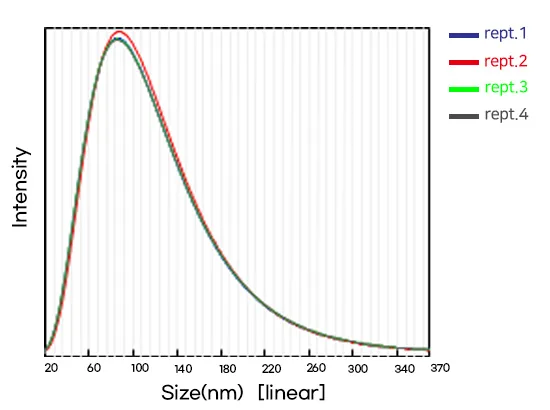
PRISM PS 91.7 nm · PDI 0.252
-
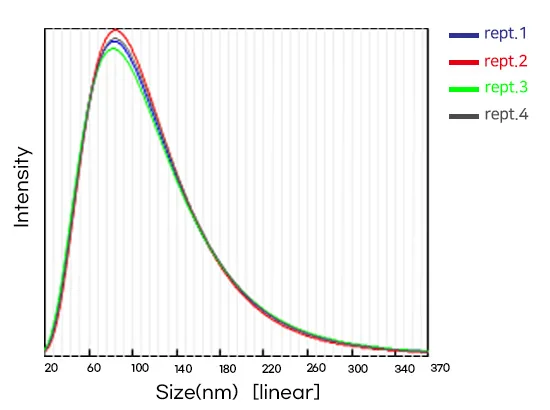
E co. PS 89.7 nm · PDI 0.265
-
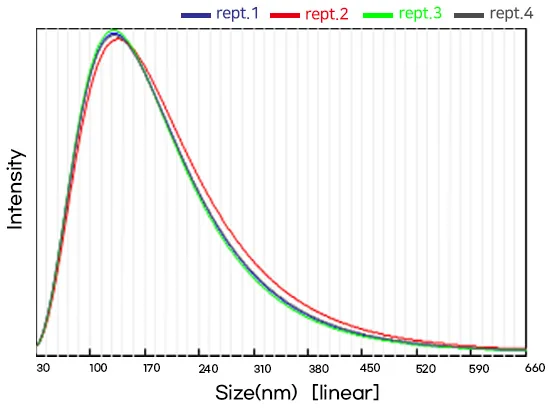
S co. PS 143.1 nm · PDI 0.452
-
Pigment
- Experience across many pigments
- Dye and pigment synthesis
- Pigment purification
-
Dispersant
- Dispersant modification
- Dispersant application
- Dispersibility control
-
Processing
- Know-how across many mills
- Dispersion stability
-
Dispersion
- More dispersion, finer and more even
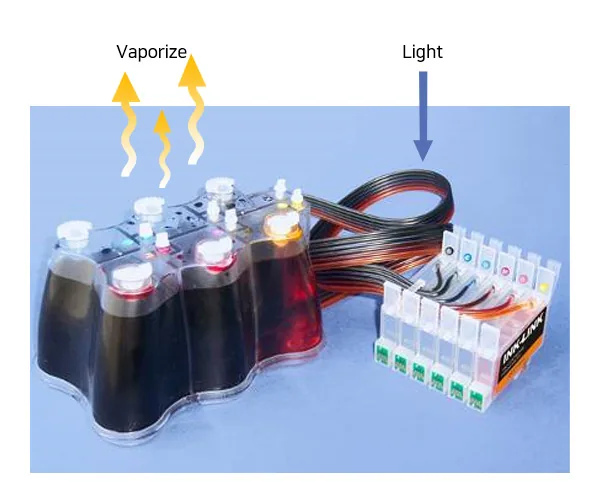
Ink for CISS
High flowability and stability for continuous ink supply systems, with light-fast dyes and stable pigments for long-term use.
Inks can change inside a CISS
- Light — attacks the colorant
- Evaporation — changes the ink properties
Required properties
- Highly light-fast dyes at sufficient concentration
- High formulation stability
- Good fluidity in micro-channels
- No gas bubbles in the ink